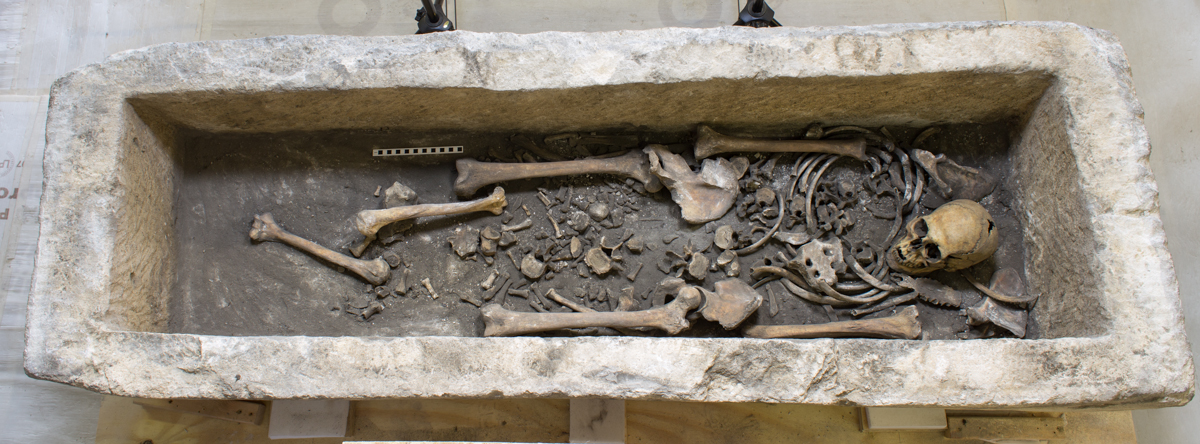
A skeleton found inside a Roman sarcophagus at Westminster Abbey may belong to an Anglo-Saxon abbot, according to new research by the Abbey’s Consultant Archaeologist, Professor Warwick Rodwell. The research builds on archaeological investigation and skeletal analysis carried out by Pre-Construct Archaeology (PCA).
The limestone sarcophagus was excavated in 1869 and bears an inscription commemorating Valerius Amandinus, who lived during the Roman period. However, a large cross carved into its lid suggests the coffin was reused for a medieval burial.
PCA investigated the sarcophagus in 2016, with human bone specialist James Langthorne examining the skeleton. He identified the remains as those of a man aged between 35 and 49, around 5ft 9in tall. The bones also showed evidence of joint disease, healed rib fractures and an infection affecting the lower right leg. The skull had been repaired, and the lower jaw wired to it in three places.
Radiocarbon dating placed the burial between AD 987 and 1052. Professor Rodwell suggests the man may have been a high-ranking medieval monk, with Ælfwig, Abbot of Westminster until around 1020, considered the most likely candidate. His successor, Wulfnoth, who died in 1049, is another possibility.
The new research revisits a burial that has puzzled researchers since the sarcophagus was discovered more than 150 years ago, with PCA’s earlier investigation providing important evidence for the reassessment.
Read more:
- Westminster Abbey: Mystery of Abbey’s Roman sarcophagus solved
- Smithsonian Magazine: Archaeologists may have solved the mystery of a Roman sarcophagus excavated at Westminster Abbey in 1869
- Professor Warwick Rodwell’s research in the Journal of the British Archaeological Association