We are pleased to announce the publication of our article, The History and Archaeology of the Wear Flint Glass Works, Trimdon Street, Sunderland (1853–1877) by John Shepherd, in Archaeologia Aeliana. The paper presents the results of archaeological investigations undertaken in advance of the Sunderland Strategic Transport Corridor Phase 3 (SSTC3).
PCA carried out a programme of archaeological work in advance of construction for SSTC3, a major infrastructure scheme designed to improve connections between the A1231, Sunderland city centre and the Port of Sunderland. Our DBA established that the proposed route crossed the former sites of a brick and tile works, the Deptford Chemical Works, the Wear Bottle Works, several shipyards, the Vulcan Iron Works, the Lambton Railway, the Sunderland Flint Glass Works, the Trimdon Iron Works, the Hetton Company Railway and a coal depot. Evaluation, monitoring and watching brief indicated that most of these remains had been removed during early 20th-century redevelopment.

This Ordnance Survey first edition map of 1862 shows the level of industrial activity in the area
Significant archaeological remains were, however, identified in several areas, most notably at the Sunderland Flint Glass Works. Excavation revealed the surviving bases of two glass cones, circular brick-built structures that housed the glass-melting furnaces and associated flue systems. In an 1860 lithograph of the neighbouring Hartley and Company’s glassworks, the chimneys associated with these cones are shown projecting above the Glass House roof.

.
The history of the glassworks reflects the wider industrial development of Victorian Sunderland. Early mapping shows a railway siding delivering raw materials, including sand and coal, directly to the site. The works initially produced blown flint glass, a high-value product earlier in the 19th century. However, the enterprise proved short-lived, failing within a few years of its establishment in 1858. The factory was subsequently taken over by James Angus and Henry Greener, who shifted production to press-moulded glass. Documentary sources from this period refer to the site as the ‘Wear Flint Glass Works’, although the 1859 mapping continued to label it as the Sunderland Flint Glass Works.
Economic changes accelerated the growth of glassmaking across the region. Following the abolition of the glass tax in 1845, and alongside the expansion of the coal industry, Sunderland developed into a major centre of glass production. Colliery railways and coastal shipping routes significantly reduced transport costs, making large-scale manufacture more economical than in centres such as London. Raw materials, including flint and sand, were commonly transported as ballast in colliery vessels returning to the Tyne and Wear, ensuring a reliable supply for local manufacturers.
But by the end of the 19th century, the glassworks had been demolished. The 1897 Ordnance Survey map shows the Trimdon Iron Works occupying part of the site, with terraced housing constructed along Trimdon Street. These were later cleared as industrial and infrastructural requirements changed, with the ironworks removed by 1946 to make way for a power station. The housing survived until the 1970s before demolition during the widening of Trimdon Street.
Excavation for SSTC3 exposed the central and southern areas of the former factory. Although the glassworks had been largely reduced to ground level, substantial elements survived, including wall foundations, floor surfaces and flues. Correlation of the archaeological evidence with the 1859 map enabled the identification of several components of the works, including two cone bases, each approximately 6m in diameter, together with elements of the underground flue system, a flue entrance to the south and parts of the annealing kiln area. Structural remains to the north corresponded with rooms labelled on the map as the Store Room, Mixing Room and Sand Depot.
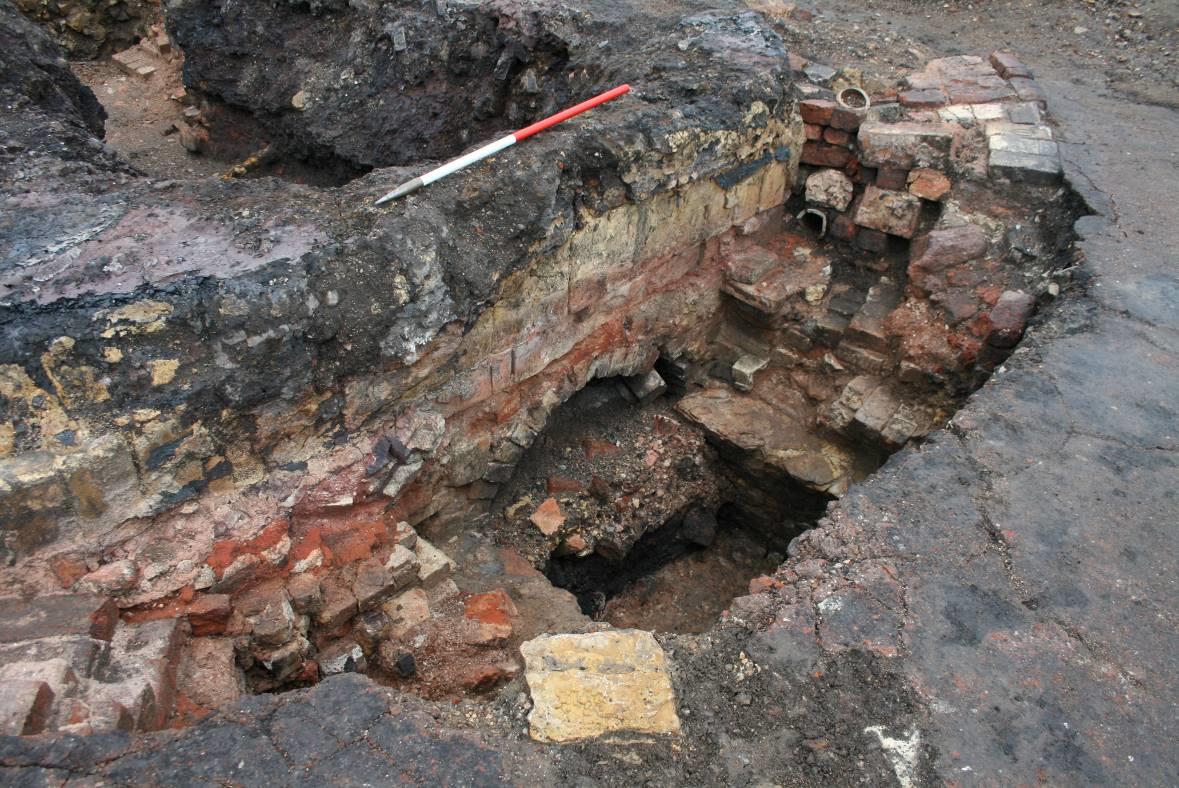
The base of the southern glass cone with arched flue entrance. These were shown on an 1859 map as ‘cones’, and were coal-fired furnaces for glass melting pots
Material recovered from the site provides further insight into glass-making processes and products. Assemblages included fragments of blown, cut and pressed vessels, including tumblers and beakers, alongside a range of pressed decorative forms. Glass-working waste exhibited a variety of compositions, including colourless flint, coloured flint and uranium-oxide glass. Fragments of clay crucibles provide direct evidence for the melting process. Documentary research has also identified changes in ownership, labour disputes and recorded incidents associated with the factory and its showroom, adding valuable context to the archaeological evidence.
Taken together, the archaeological and documentary evidence illuminates the development, operation and rapid decline of the Wear Flint Glass Works, contributing to a deeper understanding of Sunderland’s industrial past and its role within the wider 19th-century glass industry.

Pressed glass vessels made by Angus and Greener in a private collection